



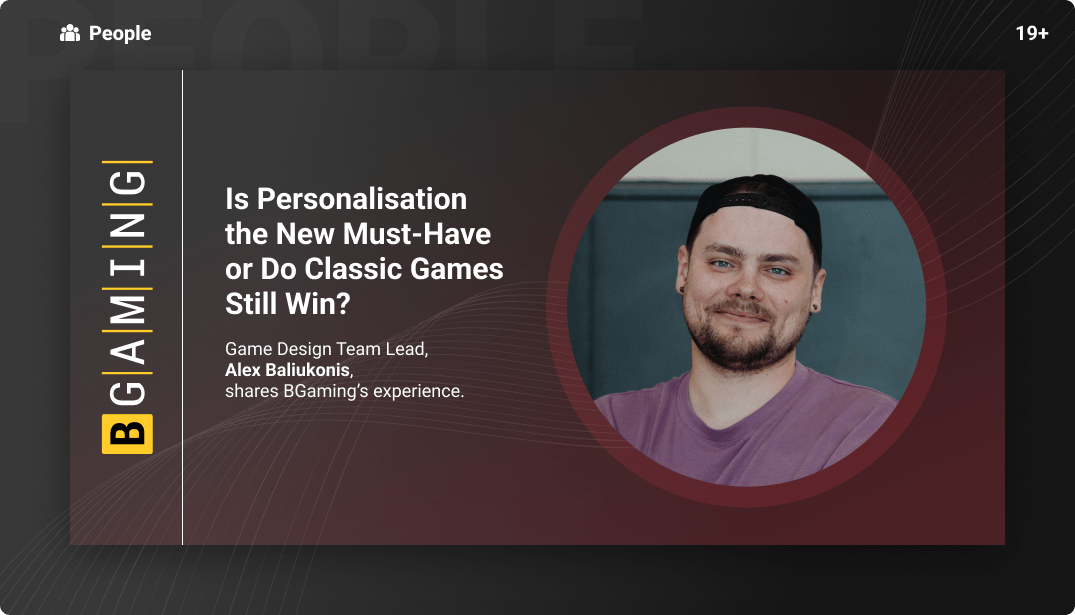

Is Personalisation the New Must-Have or Do Classic Games Still Win?
Game Design Team Lead, Alex Baliukonis, shares BGaming’s experience.
Personalisation has moved from a “nice to have” feature to one of the key forces shaping iGaming in 2026. Players no longer see games as static products. They expect experiences that reflect how they like to play: themes that feel familiar, volatility that matches their risk appetite, and features that unfold at a pace they enjoy.
At the same time, classic, evergreen mechanics still dominate mainstream behaviour. Simple structures, recognisable symbols, and straightforward gameplay continue to attract the widest audience and deliver stable results for operators.
So where is game development really heading? Is the future all about adaptive, personalised journeys, or do nostalgic, easy-to-read slots still set the standard?
To explore this question from a practical, studio-side angle, CasinoRIX, invited BGaming’s Game Design Team Lead, Alex Baliukonis, to share how their team approaches personalisation, what they are learning from live titles, and how they balance innovation with proven formulas.
How Personalisation Is Shaping Modern Slots
We can’t really call personalization a trend of 2026, because it already defined much of 2025. Players now expect games to speak directly to them: through visual style, pacing, volatility, and even the way mechanics unfold. At the same time, the broader industry is steadily shifting toward a B2B2C model, where working with operators is only part of the picture; understanding the player’s mindset is just as essential.
At BGaming, we approach personalization in two distinct ways. The first is personalization within the game itself, something we developed in titles like Merge Up™ 2 and Wild Wick. Here, character reactions, adaptive pacing, volatility choices, and mechanics aligned with particular play styles work together to make the experience feel more responsive and meaningful.
The second form is product-level personalization, which involves custom-built games tailored to operators. This is an approach we’ve successfully applied in collaborations with Stake, Betsson, BitStarz, and others. It involves creating exclusive titles shaped by a casino’s analytics — the themes its players prefer, the mechanics they engage with most, and the features that influence retention and conversion. Such games consistently outperform their base versions because they more accurately meet audience expectations and are positioned as unique offerings that add value to the operator’s brand.
Observing the market, we’ve noticed several common mistakes other studios make. Some overcomplicate personalization or obscure it behind unnecessary features. Others change mechanics simply for the sake of novelty, rather than player benefit. Some attempt to replicate a “Netflix-style” model without recognizing that a slot is not a content playlist but a dynamic gaming experience. And many underestimate the expertise of operators themselves, forgetting that casinos often have the clearest understanding of what their players actually want.
Streaming Insights In Action: Merge Up™ 2 and Wild Wick
Our partner Strmlytics provides deep insight into how players and streamers actually behave, not just through numbers, but through real emotional responses and UX observations. This is why we continually return to this collaboration when creating titles that need to resonate with streamers on a deeper level.
This approach played a significant role in the development of Merge Up™ 2. Their insights revealed that one of the core frustrations in the original needed to be addressed with a “second chance” mechanic, a feature that later became central to the sequel. They also helped identify the rising demand for expanded Buy Features and guided BGaming toward increasing the maximum win potential from x5,000 to x10,000. Understanding which UI elements confused newcomers opened a new direction for both visual execution and user experience. Personalising Merge Up™ 2 meant staying true to the original idea while elevating it in ways that aligned with player expectations.
A similar deep-dive approach shaped the development of Wild Wick. Here, Strmlytics introduced us to a “player feeling matrix,” a behavioural model that maps emotional responses to slot mechanics. Two dominant feelings emerged as essential to this title: The Unexpected — the thrill of surprise — and The Buildup — the rising tension that players and viewers experience together. Their analysis of streamer reactions showed how unpredictable and cumulative events drive engagement, helping us refine the balance between volatility and anticipation.
Strmlytics helped shape the main character into an emotional anchor, creating a connection point between the audience and the gameplay. As a result, Wild Wick introduced Surprise Wilds, multipliers, Sticky Wilds, and bonus modes tailored to different player types. We ensured that the character interacted directly with the grid, a feature that streamers particularly appreciate, and refined the UX.
Both projects demonstrate how streaming-driven insights can transform not just design decisions, but the entire emotional structure of a game. When data is enriched with real behavioural feedback, personalisation becomes not an add-on, but a foundation.
What Player Behaviour Tells Us So Far
For Merge Up™ 2, early player activity paints an interesting picture. Slightly more than half of all bets, around 51%, are made using the Chance x2 feature, while 47% of players prefer to play without activating any additional modifiers. Looking at feature conversion over a one-month average, approximately 74% of players trigger features through standard base-game spins, and 47% convert through the Chance x2 mode.
The appeal of the Chance feature is clear: it gives players the possibility to gain up to 30 free spins with marked cells whose progressive multipliers continue to grow throughout the round. This contrasts with the standard game, where marked cells retain progress only within a single refill session. Even so, nearly the same percentage of players remain satisfied with the pacing and event frequency of the main game, choosing not to activate the additional mode.
Wild Wick, meanwhile, shows a different behavioural trend. Around 72% of bets are placed in the main game without any Buy Features, which aligns with the design intention — the interactive protagonist maintains a lively flow of events without requiring players to jump into Bonus rounds. About 27% of bets are placed via the Chance x3 feature, reflecting the curiosity of a more impatient audience eager to explore alternative Bonus outcomes.
In terms of feature conversion, Wild Wick currently demonstrates an 88% conversion rate from standard base-game spins and a 40% conversion rate from Chance x3.
The main distinction between the two titles lies in the presence of an interactive character in Wild Wick and the absence of one in Merge Up™ 2. While both games have performed strongly during their first month, we cannot overlook how compelling a protagonist can be in sustaining engagement directly within the reel flow.
Together, these examples show how personalisation can sit on top of classic mechanics, rather than replacing them outright.
Personalisation, Classics, And What Comes Next
From a market-wide perspective, personalisation is clearly moving from experiment to standard practice and will continue to shape game design through 2026–2027. Players are learning to expect more control, more tailored pacing, and mechanics that feel tuned to their preferences.
At the same time, classic slot structures are not going anywhere. They still provide the comfort, clarity, and predictability that many players value, and they remain a core driver of volume across most casinos.
BGaming’s collaboration with Strmlytics is a good example of how studios can move further into personalisation without losing their identity. Instead of throwing out proven mechanics, they refine them using behavioural insight, streaming data, and operator analytics.
For CasinoRIX, the key takeaway is straightforward: the future of iGaming is not a choice between personalisation or classics. The most resilient studios will be those that keep their classic foundations strong, while using personalisation to make those foundations feel more relevant, more responsive, and more engaging for the players who sit on the other side of the screen.
Other news:
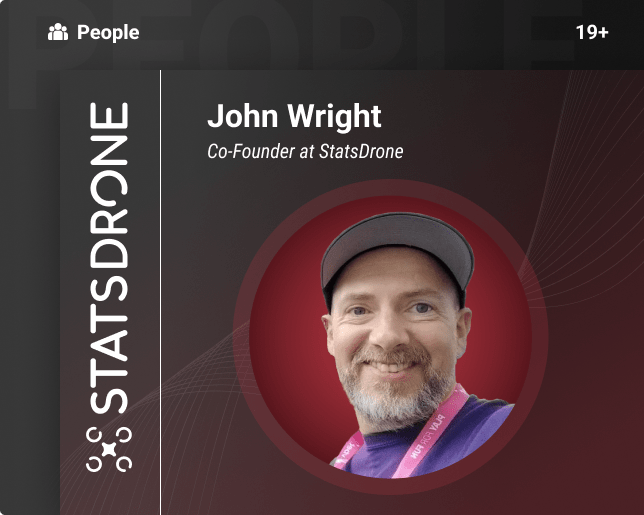
Building a Career in iGaming: John Wright’s Path from Professional Gambler to Industry Leader
With over 20 years in the iGaming industry, John’s story is one of unlikely beginnings and consistent innovation. In this interview, he recounts his unexpected entry into the world of professional gambling and how i...

Personal Manager 24/7: The Ultimate Solution for CasinoRIX Customers
At CasinoRIX, we prioritize our customers' time, and one way we show it is through our 24/7 personal manager. This service enables prompt and effective issue resolutions.
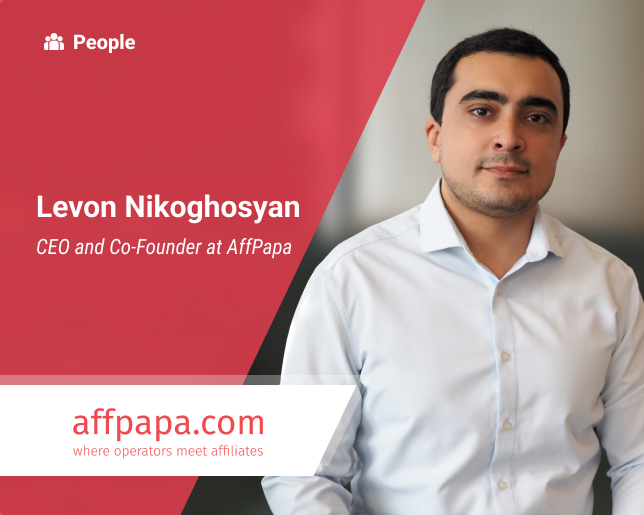
Levon Nikoghosyan talks to CasinoRIX about AffPapa, iGaming Club and insights on successful Affiliate Management
In this exclusive interview Levon Nikoghosyan, the 29-year-old entrepreneur and acting CEO of AffPapa, shares his extensive 10+ years of expertise in the iGaming industry.

Ontario’s iGaming Market: 2023-24 in Numbers
Ontario’s iGaming industry has witnessed spectacular growth since its launch in April 2022. With a regulatory framework that is lauded and well-recognized by the international gaming community, the iGaming market in...